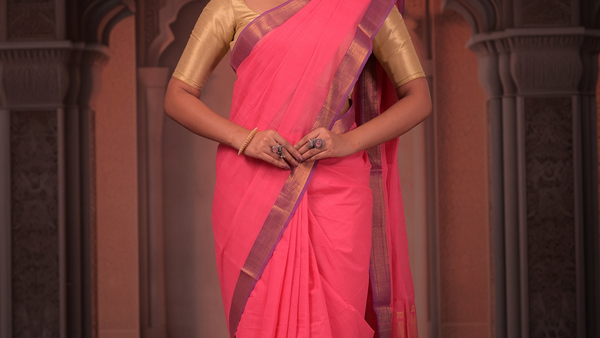

Snehal blends a degree in textile design with 10+ years in global finance. She founded Rutambhara to celebrate India’s handloom heritage and currently works directly with weaving clusters across India on fair-trade sourcing.
Quick facts
- Origin: Varanasi (Banaras), Uttar Pradesh — protected by a Geographical Indication since 2009
- Typical handloom dupatta length: 2.25–2.5 metres
- Weaving time: roughly 3–15 days for a dupatta, depending on the density of the zari work
- Real zari is silver thread electroplated with gold; “tested” zari is the half-fine version most weavers use today
- Honest price band for a genuine handloom Banarasi silk dupatta: roughly ₹8,000 upward
What actually makes a dupatta “Banarasi”
Banarasi is not a fabric. It is a weaving tradition — a way of building supplementary metallic thread into silk on a loom in and around Varanasi. That is why you will see Banarasi silk, Banarasi organza and Banarasi georgette all sold under the same name: the base cloth changes, the technique does not.
The technique is what you are paying for. In a real Banarasi, the gold you see is not printed, foiled or embroidered on afterwards. It is woven in as an extra weft that travels across the loom alongside the silk, which is why the motifs have a slight physical relief you can feel with a fingertip, and why the reverse of the cloth carries floats of thread between motifs.
Banarasi weaving carried a Geographical Indication tag from 2009, covering Varanasi and the districts around it. The GI is about origin, not quality — it tells you where a piece was made, not whether it was made on a handloom or a powerloom. Those are two different questions, and the second one is the one that changes what you should pay.
The main types of Banarasi dupatta
There are two useful ways to sort them. The first is by base fabric, which decides weight and drape.
| Base fabric | What it feels like | Best for |
|---|---|---|
| Katan silk | Pure twisted silk. Dense, smooth, holds a sharp pleat. The classic. | Weddings, occasion wear, anything you want to keep for decades |
| Organza (kora) | Crisp, sheer, stands slightly away from the body | Layering over plain suits; summer occasions |
| Georgette | Soft, fluid, falls close and long | Slimming drapes and taller silhouettes |
| Tissue | Shimmering, very light, high zari content | Evening events where you want the light to catch |
| Shattir | The lightest and least expensive base | Contemporary, everyday-festive pieces |
The second is by design family, which decides how the surface is filled.
- Jangla — a dense, sprawling vine pattern that covers the whole field. The most maximal of the lot.
- Butidar — scattered individual motifs (buti) across an otherwise plain ground. The easiest to wear.
- Jaal — a repeating net or trellis of connected floral motifs. Our own Banarasi dupattas are mostly floral jaal.
- Tanchoi — no cut zari floats at all; the pattern is built from multiple coloured silk wefts, so the reverse is smooth.
- Cutwork — the flat, mass-market cousin, where the floats behind the motifs are literally cut away after weaving.
If you only remember one thing here: Tanchoi has a clean reverse by design, everything else should not. A Katan jaal dupatta with a suspiciously tidy back has usually been cutwork-finished, and that tells you something about how it was made.
How to spot a real handloom Banarasi silk dupatta
You can do most of this in a shop, in about ninety seconds.
- Turn it over first. On a genuine handwoven jaal or butidar piece, the reverse shows loose floats of zari and silk running between motifs. A perfectly clean, machine-neat back on anything other than a Tanchoi means powerloom or cutwork.
- Look for the irregularity. Handloom cloth has tiny variations — a slightly uneven selvedge, a motif that sits a hair off the repeat. Powerloom output is metronomically identical. The flaw is the signature.
- Feel the weight. Katan silk has a density that art silk cannot fake. A “Banarasi silk” dupatta that feels papery and slick is almost certainly polyester.
- Test the zari, gently. Real (or tested) zari is metal on a silk core; it tarnishes very slowly and warms in your hand. Plastic-coated imitation zari stays cold, feels slippery, and frays into a shiny filament rather than a fine wire.
- Check the price against the loom. A handloom weaver spends days on a single dupatta. A pure-silk handwoven Banarasi dupatta under about ₹8,000 should raise a question, not a bargain reflex.
- Ask who wove it. A seller who can tell you the cluster, the weaver family, or at minimum “handloom, Varanasi” is a seller who knows their supply chain. Vagueness is an answer too.
The burn test, and why we don’t recommend it
You will read that real silk burns to a brittle ash and smells of burnt hair, while polyester melts into a hard bead. That is true. It is also destructive, unreliable on blends, and impossible to do on a piece you do not yet own. Use the reverse-side and zari checks instead — they tell you more, and they leave the dupatta intact.
Real zari vs everything else
Three grades circulate, and the vocabulary is deliberately slippery:
- Pure zari (kalabattu) — a silk core wrapped in silver wire, gilded with gold. Rare now, priced accordingly, and it is what antique Banarasis were made with.
- Tested zari — silver-electroplated copper or a silver-content thread. This is what most serious handloom Banarasi work uses today, and it is a legitimate, durable choice.
- Imitation zari — metallised polyester film. It looks bright on day one and dulls or flakes with wear.
“Tested” is not a euphemism for fake; it is the honest middle. What you want to avoid is a seller who says only “gold zari” and cannot tell you which of the three they mean.
Six ways to style a Banarasi dupatta
- Over a plain silk-cotton suit. The single most effective use. Let the suit be quiet and the dupatta do all the work — a solid kurta in an undyed or single-tone fabric turns a heavy jaal dupatta into the entire outfit.
- Front-pleated on one shoulder. Pleat to 4–5 inches, pin at the shoulder, and let the pallu fall long down the back. This is the drape that reads formal without becoming fussy.
- As a saree pallu substitute. Pair a Banarasi dupatta with a plain silk saree and drape it as a second layer over the shoulder. It is how a lot of people get two looks out of one piece.
- Belted at the waist. A slim tan or antique-gold belt over a straight-fall dupatta creates a vertical line and stops the fabric swamping a petite frame.
- Over a solid gown or a plain kurta-and-palazzo. Modern, and it works precisely because the silhouette underneath is unbroken.
- Double-shoulder, both ends free. The least structured option, best for organza and georgette bases that fall rather than stand.
If you want the mechanics of pleating and pinning in detail — pleat widths, lengths by height, how to stop a silk dupatta sliding — we wrote all of it up in our dupatta draping guide.
Caring for it
- Dry clean only, and tell the cleaner it is zari work. Water and household detergent will dull metallic thread quickly.
- Never hang it on a hanger long-term. The weight of the zari pulls the silk out of shape. Fold it, with the fold lines changed every few months so a permanent crease never sets.
- Wrap it in cotton muslin, not plastic. Silk needs to breathe; sealed plastic traps moisture and yellows it.
- Keep it out of direct sunlight and away from perfume sprayed onto the fabric itself.
- Air it twice a year. Ten minutes in shade, refolded differently. That single habit is what gets a Banarasi to the next generation.
What we weave, and what it costs
Our Banarasi dupattas are handloom silk with gold zari, currently ₹9,700–₹14,200. Every one is a single piece — when a colourway sells, that exact dupatta is gone, because we buy from weavers by the piece rather than by the batch. Most of the current set is floral jaal with a zari border; a few are butidar with small buttas on a plain ground, which are the easier ones to wear outside a wedding.
They sit in our Signature tier, which is where handwoven occasion pieces live. If you want handloom without the zari weight, our Premium handloom dupattas cover the everyday end, and the full silk dupatta range sits between the two.
Frequently asked questions
How much should a real Banarasi dupatta cost?
A genuine handloom Banarasi silk dupatta realistically starts around ₹8,000 and rises with the density of zari work and the fineness of the silk. Organza and georgette bases sit lower; heavy Katan jaal sits higher. Anything advertised as handwoven pure silk at ₹2,000 is a powerloom or art-silk piece.
Can I wear a Banarasi dupatta with a cotton suit?
Yes, and it is one of the better combinations. The contrast between a matte handloom cotton kurta and a zari-woven silk dupatta is deliberate and reads as considered rather than mismatched. Keep the kurta plain.
What is the difference between Banarasi and Kanjivaram zari work?
Banarasi zari is a supplementary weft woven into a silk ground, usually in Mughal-derived floral and vine motifs. Kanjivaram uses a heavier zari and a distinctive korvai join where the contrast border is interlocked with the body. Different regions, different looms, different weight in the hand.
Is Banarasi organza the same as Banarasi silk?
No. Organza (kora) is a sheer, crisp base — lighter, more transparent and less expensive than Katan silk. The Banarasi zari technique is the same; the cloth it sits on is not.
How do I know if the zari is real gold?
Almost none of it is solid gold. Pure zari is silver wire gilded with gold; most current handloom work uses silver-electroplated “tested” zari, which is legitimate. Imitation zari is metallised polyester — it feels cold and slick, and it frays into a shiny film rather than a wire.
How long does a Banarasi dupatta take to weave?
Roughly 3 to 15 days on a handloom, depending on how much of the surface the zari covers. A dense jaal takes far longer than scattered buttas, which is most of the reason two silk dupattas of the same size can be priced very differently.
Shop the weave
- Banarasi Dupattas — handloom silk with gold zari, single pieces
- Signature Handloom Dupattas — collector-grade occasion weaves
- Premium Handloom Dupattas — everyday handwoven dupattas
- Silk Dupattas — the full silk range across crafts
- Banarasi Dress Materials — unstitched sets in the same weave