
Snehal blends a degree in textile design with 10+ years in global finance. She founded Rutambhara to celebrate India’s handloom heritage and works directly with weaving and printing clusters across India on fair-trade sourcing.
Quick facts
- “Silk saree” answers two separate questions: which fibre (mulberry, tussar, eri, muga, or a silk-cotton blend) and which weave (Kanjivaram, Banarasi, Paithani, Chanderi, Maheshwari, Bhagalpuri…).
- Mulberry is the smooth, lustrous, expensive one. Tussar is textured, matte and golden. Silk-cotton is the light, breathable, everyday one.
- Weight and sheen are set by the fibre; drape and pattern are set by the weave. Choose the fibre for the weather and the occasion, then the weave for the look.
- A “pure silk” label should mean 100% silk fibre, though many honest sarees are blends — the label just needs to say so.
Start with the fibre, not the name
Most silk-saree confusion comes from mixing up the two things a name can describe. “Kanjivaram” is a weave from a town; the fibre is mulberry silk. “Tussar” is a fibre; you can weave it into a Bhagalpuri, a Jamdani or a plain. “Chanderi silk” is a weave whose classic version is a silk-and-cotton blend. Once you separate the fibre from the weave, every listing becomes readable: fibre tells you how it will feel, fall and wear; weave tells you how it will look.
The fibres
Mulberry silk
The silk of the Bombyx mori moth, fed on mulberry leaves, reeled as one continuous filament. It is the smoothest, strongest and most uniform silk, with the high shine people picture when they hear the word. Karnataka is India’s main producer. Mulberry is what Kanjivaram, Banarasi, Paithani, Mysore and most bridal silks are woven from. Its weaknesses are heat — it does not breathe like cotton — and price.
Tussar (Kosa) silk
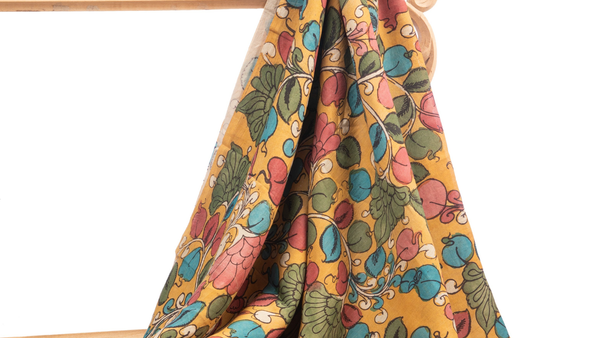
Wild or semi-wild silk from Antheraea moths that feed on forest trees, produced mainly in Jharkhand, Chhattisgarh and Bihar. The filament is coarser and naturally golden-brown, so tussar has a dry, textured hand, a soft matte glow rather than a shine, and takes dye in slightly muted tones. It is lighter than mulberry, breathes better, and is the base of Bhagalpuri silks, many Jamdani-on-tussar pieces, and hand-painted kalamkari sarees.
Eri and Muga
The two Assamese silks. Eri (“peace silk”) is spun rather than reeled from an open-ended cocoon, giving a warm, slightly woolly cloth that is worn in the North-East as much for cold as for ceremony. Muga is the rare, naturally golden silk that only Assam produces; it darkens and grows glossier with washing and is worn for Assamese weddings and Bihu. Both are niche in the saree market outside the region, but you will see eri appearing in stoles and in some Kutch-woven pieces.
Silk-cotton
Not a fibre but a construction: silk in one direction of the weave (usually the warp) and cotton in the other, or a plied yarn of both. The result is lighter, cooler and cheaper than pure silk with a good part of its sheen. Chanderi, Maheshwari, Mangalagiri silk-cotton and Gadwal all live here. For Indian summers and for anyone who wears sarees regularly, silk-cotton is the workhorse — which is why our Silk Cotton Sarees is one of the largest collections on the site.
The weaves
Kanjivaram (Kanchipuram)
Tamil Nadu’s temple silk. Heavy mulberry with a separately woven border and pallu joined to the body by the korvai technique — you can see the join as a fine zigzag on the reverse. Traditional motifs are temple spires, checks, peacocks and mangoes in real or tested zari. The weight is the point: a Kanjivaram falls in sculptural pleats and lasts generations. Bridal and the biggest occasions. See our Kanjivaram Sarees.
Banarasi
Varanasi’s brocade. Mulberry silk (katan) with supplementary zari or resham patterning across the body — jaal trellises, buti sprigs, Mughal florals. Sub-types by technique: Kadhwa (each motif woven separately, no floats on the back), Cutwork (floats trimmed), Tanchoi (multi-colour resham, no zari), Jangla (dense creepers). Softer than Kanjivaram, more fluid, and the widest range from wedding-heavy to a light Tanchoi you can wear to dinner. Our Banarasi saree guide goes into the types.
Paithani
Maharashtra’s peacock silk. Mulberry silk body with a pallu in tapestry technique — the design is woven in with interlocking coloured wefts, so it is identical front and back — showing peacocks, lotuses and parrots. The border is typically a solid zari band with an oblique-square kath edge. Slow to weave and priced accordingly; a Paithani is a family piece.
Chanderi
Madhya Pradesh. Sheer, glassy and very light, traditionally silk warp with fine cotton weft, patterned with small zari butis. There is also a pure-silk Chanderi and a Chanderi cotton; the silk-cotton is the classic. Best for humid weather, day weddings and anyone who finds heavy silk a chore. Our Chanderi Sarees.
Maheshwari
Also Madhya Pradesh, from the town on the Narmada. Silk-cotton with a plain or fine-striped body and a distinctive reversible border of stripes and small geometric motifs, often with a two-colour shot effect. Lighter than Chanderi in look, a little more opaque, and one of the best sarees for daily-to-office wear. Our Maheshwari Sarees.
Bhagalpuri and other tussar weaves
Bhagalpur in Bihar is the tussar capital; a “Bhagalpuri silk” is generally a plain or lightly patterned tussar. Tussar also carries Jamdani work from Bengal and hand-painted or printed surfaces (kalamkari, Madhubani, block print). Rich, matte, and the most forgiving silk in hot weather.
Mysore silk and the crepes
Karnataka’s mulberry crepe: plain body, zari border, very fine and fluid. The go-to for a plain silk in a strong colour. Also the base for many printed silk sarees.
Choosing between them
| Saree | Fibre | Weight | Sheen | Best for |
|---|---|---|---|---|
| Kanjivaram | Mulberry | Heavy | High | Weddings, once-a-year occasions |
| Banarasi | Mulberry | Medium–heavy | High | Weddings, festivals, receptions |
| Paithani | Mulberry | Medium–heavy | High | Weddings, heirloom |
| Mysore crepe | Mulberry | Light | High | Plain silk for any occasion |
| Tussar / Bhagalpuri | Tussar | Light–medium | Matte glow | Festive day wear, warm weather |
| Chanderi | Silk-cotton | Very light | Sheer gloss | Humid weather, day functions |
| Maheshwari | Silk-cotton | Light | Soft | Office, everyday, small functions |
A rule that rarely fails: for anything in summer or the monsoon, go silk-cotton or tussar; for winter weddings and evening receptions, go mulberry. For a full taxonomy of Indian sarees beyond silk, our 41 types of sarees guide covers every region.
Reading a label honestly
- “Pure silk” should mean 100% silk fibre, any type. It says nothing about zari or weave quality.
- “Art silk”, “silk blend” without a percentage, “soft silk” — these usually mean polyester or viscose, or a mostly-synthetic mix. A burn test settles it: real silk smells of burning hair and leaves a crushable ash; synthetic melts to a hard bead.
- “Silk mark” is the Central Silk Board’s certification tag for pure silk. It is a reasonable guide, though its absence does not prove a blend.
- Zari is a separate question. Real zari is silver-gilt thread; tested zari is copper-based; “zari” on a budget saree is polyester film. On a heavy Kanjivaram or Banarasi the zari is a large part of the price, so ask.
- Handloom vs powerloom is a third question again. Handwoven silks show tiny irregularities in the weft, a slightly softer edge to motifs, and a selvedge that is not machine-perfect. All the sarees in our Silk Sarees collection are handwoven; the listing names the fibre for each.
Caring for silk
- Dry-clean heavy zari silks. For plain mulberry, tussar and silk-cotton, a cold hand-wash in a silk shampoo is fine — no soaking, no wringing.
- Dry flat or over a wide rod in shade. Never hang a wet silk saree by one end; the weight distorts the weave.
- Iron on the silk setting, on the reverse, through a cotton cloth. Zari goes dull if it takes the iron directly.
- Store in a breathable cotton bag, refolded every few months so the zari does not crack along one crease. Never in plastic; mulberry silk needs air.
- Keep silk away from perfume and deodorant — the alcohol stains and weakens it.
Muga and eri actually improve with washing and can take slightly rougher handling than mulberry. Tussar softens over time; the first wear is the stiffest it will ever be.
Where each sits in our range
Our Signature Handloom Sarees are where the heavier Banarasi, Paithani and Kanjivaram pieces live, and the Collector’s Edit holds the heirloom-grade pieces above them. The Silk Cotton Sarees — Chanderi, Maheshwari, Mangalagiri — are the everyday and festive-day range. If you want the silk in unstitched form, Silk Dress Materials carry the same weaves as suit sets.
Silk at Rutambhara
- Silk Sarees — mulberry, tussar and silk-cotton, fibre named on each listing
- Kanjivaram · Chanderi · Maheshwari
- Signature Handloom Sarees · Collector’s Edit
Frequently asked questions
What is the difference between mulberry silk and tussar silk?
Mulberry silk is reeled from cultivated Bombyx mori cocoons and is smooth, uniform and highly lustrous. Tussar is a wild silk with a coarser, naturally golden filament, giving a textured, matte cloth that is lighter and breathes better.
Is Chanderi a pure silk saree?
The classic Chanderi is a silk-cotton blend — silk warp with fine cotton weft — which is why it is so sheer and light. Pure-silk and pure-cotton Chanderis also exist; check the fibre on the listing.
Which silk saree is best for hot and humid weather?
Silk-cotton weaves such as Chanderi, Maheshwari and Mangalagiri, or a tussar. Heavy mulberry silks like Kanjivaram and Banarasi are best kept for air-conditioned or winter occasions.
How can I check whether a saree is real silk?
A burn test on a loose thread: real silk smells like burning hair and leaves a crushable ash, while synthetic melts into a hard bead. The Silk Mark tag from the Central Silk Board is also a reasonable indicator.
What does 'pure silk' mean on a saree label?
It should mean the fibre is 100% silk of any type — mulberry, tussar, eri or muga. It does not tell you the weave, whether it is handloom, or whether the zari is real.
Can I wash a silk saree at home?
Plain mulberry, tussar and silk-cotton sarees can be hand-washed cold in a silk shampoo without soaking or wringing, then dried flat in shade. Heavy zari sarees should be dry-cleaned.