
Snehal blends a degree in textile design with 10+ years in global finance. She founded Rutambhara to celebrate India’s handloom heritage and works directly with weaving and printing clusters across India on fair-trade sourcing.
Quick facts
- Sharad Navratri 2026 begins on Sunday 11 October and runs nine nights to Dussehra on 20 October.
- Each day honours a form of the goddess and, in the widely followed tradition, carries a colour. The order shifts every year with the weekday the festival starts on.
- This year’s sequence, starting from Sunday: orange, white, red, royal blue, yellow, green, grey, purple, peacock green.
- Nine days means nine outfits or, more sensibly, four or five pieces and a plan for dupattas and blouses.
Where the nine colours come from
The colour-a-day custom is strongest in Maharashtra and Gujarat and has spread everywhere through offices, schools and housing societies that now run their own Navratri dress codes. It maps a colour to each weekday — orange for Sunday, white for Monday, red for Tuesday, royal blue for Wednesday, yellow for Thursday, green for Friday, grey for Saturday — and then adds purple and peacock green for the eighth and ninth days. Because the festival begins on a different weekday each year, the list rotates. Whatever list your office circulates will almost certainly follow this logic; if yours differs, follow it, and use this post for what to wear in each colour.
The point of this guide is not the colours. It is that most people buy nine cheap synthetic outfits and wear each once. A handloom wardrobe does the opposite: a few good pieces, worn for years, with the colours carried by blouses, dupattas and borders as much as by whole garments.
Plan in pieces, not outfits
Before the day-by-day, the strategy. You need:
- Two or three cotton or silk-cotton sarees in strong festival colours — these do the weekday evenings.
- One silk piece for Ashtami or Navami, whichever your family treats as the big night.
- One suit set for the day you will be on your feet at a garba or dandiya.
- Dupattas and blouses to cover the colours you do not own as a full garment. A grey day is much easier as a grey Chanderi dupatta over a cream kurta than as a grey saree you will never wear again.
Our Latest Handloom Saree Designs and Dupattas are the two places to start; the guide below points to the specific weave for each colour.
Day by day
Day 1 — Sunday 11 October — Orange (Shailaputri)
Orange is the easiest handloom colour there is. Marigold and rust cottons from Mangalagiri, a kesar Chanderi with a gold border, a saffron silk-cotton. Wear it as a saree on day one — it is the ghatasthapana, and the first evening is when people notice. A plain Mangalagiri saree in marigold with a contrast blouse is exactly right.
Day 2 — Monday 12 October — White (Brahmacharini)
White for a working Monday. An off-white or cream handloom cotton saree with a coloured border, or a white Chanderi kurta with a silver-zari dupatta. If you avoid white sarees, a cream kurta with a white Jamdani or Chikankari dupatta reads as the colour without the risk. See Handloom Cotton Sarees.
Day 3 — Tuesday 13 October — Red (Chandraghanta)
Red is the colour handloom does best. A madder-red Ajrakh silk-cotton, a red Maheshwari with a gold border, a red Bandhani. This is a saree day. If you have one red silk and are saving it for Ashtami, wear a red blouse and a red dupatta over a cream suit today instead, and keep the silk.
Day 4 — Wednesday 14 October — Royal Blue (Kushmanda)
Royal blue is where indigo crafts shine: an indigo Dabu-printed cotton, a blue Bandhani, a peacock-blue Chanderi. Mid-week, so choose something that goes from office to evening — a blue silk-cotton saree or a blue kurta with a printed dupatta. Our Silk Cotton Sarees are the right weight for a long day.
Day 5 — Thursday 15 October — Yellow (Skandamata)
Haldi yellow, mustard, turmeric. A yellow Kota Doria with zari checks is the classic festive look in this colour and light enough for a garba night. A mustard Maheshwari or a yellow Ajrakh-printed cotton suit set works for the day.
Day 6 — Friday 16 October — Green (Katyayani)
Green is the colour of the festival in much of the country and the colour with the widest range in handloom: parrot-green Mangalagiri, bottle-green Maheshwari, leaf-green Chanderi with gold, an olive Ajrakh. Friday is usually the first big garba night, so wear the piece you can move in — a green suit set from Handloom Dress Materials, tailored with a flared kurta, or a light green silk-cotton saree pinned securely.
Day 7 — Saturday 17 October — Grey (Kalaratri)
The hard one. Very few people own a grey saree, and you do not need to. A grey Chanderi or Maheshwari dupatta with silver zari over a white or ivory kurta, or a silver-grey blouse with a white saree, covers it. If you do want a saree, a grey-and-silver Chanderi is beautiful and will get worn again for winter evenings. See Chanderi Sarees.
Day 8 — Sunday 18 October — Purple (Mahagauri)
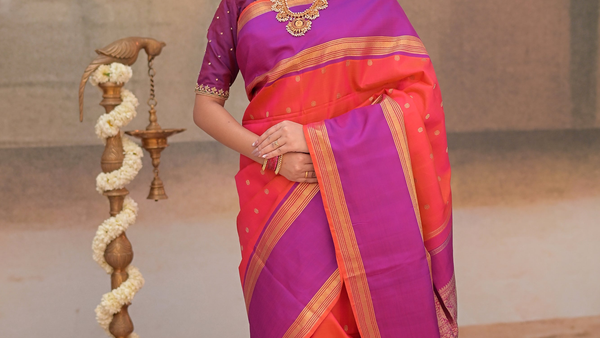
Ashtami, the big night in most Gujarati and Maharashtrian homes and the night to bring out silk. A purple Maheshwari silk with a gold border, a violet Banarasi silk dupatta over an ivory suit, a purple-and-gold Kanjivaram if you own one. Our Silk Sarees and Maheshwari Sarees both carry the colour.
Day 9 — Monday 19 October — Peacock Green (Siddhidatri)
Navami, the last night, and the colour that closes the festival: the blue-green of a peacock’s neck. Teal silk-cotton, a peacock Bandhani, a teal Chanderi with a copper border. Then Dussehra on the 20th — often a family lunch, for which a plain cream or ivory handloom with a coloured border is a graceful end to the week.
Fabric for garba nights
Dancing in a saree is a skill; dancing in a badly chosen saree is a hazard. For any night you will be at a garba or dandiya:
- Choose cotton, silk-cotton or Kota — anything that breathes. Heavy silk gets heavier as the night goes on.
- Pin the pallu at the shoulder and at the waist, and tuck the pleats well. A saree pin at the hip stops the drape moving as you turn.
- If you prefer a suit, ask the tailor for a kalidar or A-line kurta with a good flare and a full-length lining; a straight kurta restricts the step.
- Skip trailing dupattas. Fold it once and pin it as a stole, or carry a shorter one.
- Jewellery: oxidised silver or light gold. Dandiya sticks and heavy chandbalis do not mix.
Blouses and dupattas: the colour multipliers
Nine colours from five garments is entirely possible if the blouses and dupattas do the work. A cream handloom saree becomes white with a white blouse, grey with a grey blouse and silver bangles, and yellow with a yellow blouse and a yellow Bandhani dupatta draped as a stole. A red-bordered Mangalagiri saree is red on Tuesday and orange on Sunday depending on which colour you put beside it. Our Bandhani Dupattas are useful here because Bandhani comes in exactly the bright festival palette.
For the rest of the season — Karwa Chauth, Diwali, the wedding weeks — most of the same pieces carry over. Our Ganesh Chaturthi handloom edit covered the fabric-first thinking for multi-day festivals in more detail, and it applies here unchanged.
When to order
Handwoven sarees are single-piece stock and blouse stitching slows down in October. Order at least two weeks before the festival for anything you want stitched, and allow a week for a ready-to-wear dupatta or saree with a stitched blouse already in hand. The colours that sell out first every year are red, green and peacock green — buy those before the greys.
Navratri at Rutambhara
- Latest Handloom Sarees · Silk Cotton Sarees
- Handloom Dress Materials — for garba nights, cut to your fit
- Dupattas · Bandhani Dupattas — the colour multipliers
Frequently asked questions
What are the nine colours of Navratri 2026?
Starting from Sunday 11 October 2026 the widely followed sequence is orange, white, red, royal blue, yellow, green, grey, purple and peacock green. The order rotates each year with the weekday the festival begins on, so check your local or office list.
Which fabric is best for garba and dandiya nights?
Handloom cotton, silk-cotton (Chanderi, Maheshwari, Mangalagiri) or Kota Doria. They breathe and are light enough to dance in. Save heavy silks for Ashtami or an indoor evening.
Do I need nine separate outfits for Navratri?
No. Four or five handloom pieces plus blouses and dupattas in the remaining colours cover all nine days. A cream saree, for example, reads as white, grey or yellow depending on the blouse and dupatta.
What should I wear on the grey day of Navratri?
A grey Chanderi or Maheshwari dupatta with silver zari over a white or ivory kurta, or a silver-grey blouse with a white saree. A full grey saree is optional.
Which day of Navratri should I wear silk?
Ashtami (day eight) or Navami (day nine), whichever your family treats as the main celebration. In 2026 those fall on 18 and 19 October, in purple and peacock green.
How early should I buy handloom sarees for Navratri?
Two to three weeks before the festival if you need a blouse stitched. Handwoven pieces are single-piece stock, and red, green and peacock green sell out first.