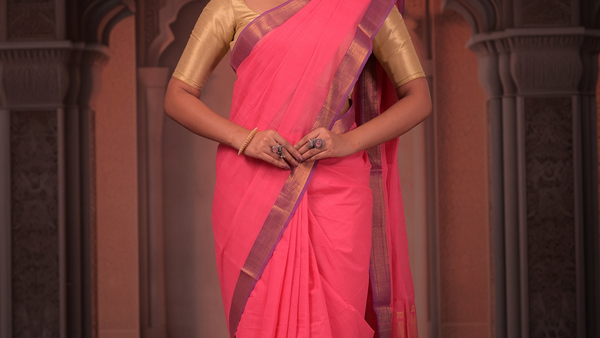

Snehal blends a degree in textile design with 10+ years in global finance. She founded Rutambhara to celebrate India’s handloom heritage and works directly with weaving and printing clusters across India on fair-trade sourcing.
Quick facts
- Standard dupatta length: 2.25–2.5 metres. Occasion pieces run to 2.8–3 metres.
- Woven crafts (Banarasi, Jamdani, Ikat) hold structure. Printed and dyed crafts (Ajrakh, Bandhani, Kalamkari) fall softer.
- Rule of thumb: the busier the dupatta, the plainer everything under it.
- Twelve styles below, grouped by how they are made — woven, resist-dyed, printed, embroidered.
How to read this list
Dupattas get grouped by region in most guides, which is not very useful when you are standing in front of a wardrobe. What actually decides whether a dupatta works with an outfit is how it was made, because that determines its weight, its drape and how loud it is. So the twelve below are grouped by technique.
Woven dupattas — pattern built into the cloth
1. Banarasi
Silk with metallic zari woven in as a supplementary weft, from Varanasi. The most formal dupatta in Indian dress, and the one that turns a plain suit into occasion wear on its own. Heavy, structured, holds a sharp pleat.
Wear with: a solid silk or silk-cotton kurta, nothing else patterned. Avoid: pairing with any other zari.
Ours: Banarasi dupattas, handloom silk with gold zari, ₹9,700–₹14,200. There is a full Banarasi dupatta guide if you want the detail on spotting real handloom work.
2. Jamdani
A discontinuous supplementary weft technique from Bengal, where each motif is worked in by hand as the cloth is woven — no jacquard, no needle. The result is almost weightless, with motifs that appear to float in the fabric. UNESCO lists it as intangible cultural heritage.
Wear with: plain cotton or linen. It is the dupatta for heat.
Ours: Jamdani dupattas from ₹2,050.
3. Ikat
Resist-dyed in the yarn before weaving, so the pattern is in the thread rather than on the surface. Pochampally's geometry is crisp; Odisha's Sambalpuri bandha curves. Both are unmistakably graphic.
Wear with: a single solid colour pulled from the dupatta itself. Avoid: any second pattern.
Ours: Ikat dupattas from ₹4,400, including handwoven Sambalpuri pieces. The ikat guide covers how to tell the traditions apart.
4. Chanderi
From Madhya Pradesh — a silk-cotton blend with a distinctive glassy transparency, because the cotton yarn is not degummed. Light, slightly crisp, with small zari or thread buttis. The best compromise between formal and wearable.
Wear with: almost anything plain. Chanderi is the most forgiving dupatta on this list.
5. Kota Doria
Rajasthan's square-check khat weave, alternating cotton and silk yarn to produce a fabric so light it is often compared to gauze. Barely there in summer, and it takes a print well.
Wear with: cotton kurtas in daytime heat. Avoid: heavy pinning — the weave is delicate.
6. Tussar and Muga silk
Wild silks with natural colour — tussar a warm honey-brown, Assam's muga a deep gold that does not need dyeing. Both have a matte, textured surface rather than a bright sheen, which makes them read as understated even at high prices.
Wear with: earth tones, and silver rather than gold jewellery.
Ours: Tussar dupattas, and several muga tussar pieces inside the silk dupatta range.
Resist-dyed dupattas — the colour is withheld, not added
7. Bandhani
Gujarat and Rajasthan's tie-dye. Thousands of tiny points are tied off by hand before the cloth goes into the dye, and each knot becomes a dot. A fine bandhani dupatta can carry tens of thousands of individual ties, which is the whole of its price.
The tell: untie a corner and the dots should be slightly irregular, with the tying puckers still visible in the cloth. Printed "bandhani" is flat and perfectly regular.
Ours: Bandhani dupattas, ₹5,540–₹12,390.
8. Ajrakh
Kutch's natural-dye resist block print, built on indigo and madder across fourteen to twenty stages, and traditionally printed on both sides of the cloth. Geometric, deep-toned, and it behaves like a neutral once you get used to it.
Wear with: undyed or single-tone cotton, and oxidised silver.
Ours: Ajrakh dupattas from ₹900 in cotton up to ₹8,990 in muga tussar. Full detail in the Ajrakh guide.
Printed and painted dupattas
9. Kalamkari
Andhra Pradesh's pen-and-block craft — kalam means pen. Srikalahasti work is drawn freehand with a bamboo pen and natural dyes, usually narrative; Machilipatnam work is block-printed. Either way the palette is mineral: rust, indigo, black, undyed cream.
Wear with: plain kurtas in one of the dupatta's own colours. Kalamkari is a picture, so let it be looked at.
Ours: Kalamkari dupattas, ₹4,610–₹6,900.
10. Hand block prints — Bagru, Dabu and Sanganeri
Rajasthan's three block-printing traditions. Sanganeri is fine floral on white; Bagru uses mud-resist and iron-black on off-white; Dabu is the mud-resist technique itself, giving soft, slightly mottled indigo. All three are cheerful, washable and made for daily wear.
Wear with: handloom cotton. This is the everyday end of the category.
Ours: across the cotton and silk-cotton dupatta ranges.
Embroidered and needle-worked dupattas
11. Phulkari
Punjab's floral darning stitch, worked in bright floss silk on a coarse khaddar ground — traditionally from the reverse, so the maker works blind to the front. A bagh is the fully covered version where no base cloth shows at all. Old family pieces are genuinely heirlooms.
Wear with: solid black, white or deep jewel tones. It needs a plain field to sit against.
12. Chikankari and Kashmiri needlework
Two different traditions that share a logic: white or tonal thread on fine cloth, so the pattern is texture rather than colour. Lucknow's chikankari uses around thirty stitches on cotton, mul or georgette. Kashmir's sozni and tilla work runs finer and denser, usually on pashmina or wool, and a hand-embroidered Kashmiri shawl-dupatta can take a year.
Wear with: anything. Tonal embroidery is the most versatile decoration on this list.
Choosing by occasion, in one table
| Occasion | What works | Why |
|---|---|---|
| Office / daytime | Ajrakh, block print, Jamdani, Kota | Light, washable, quiet |
| Festive daytime | Chanderi, Ikat, Kalamkari | Visible craft without weight |
| Wedding / evening | Banarasi, Bandhani, Tussar-Muga | Structure and depth under artificial light |
| Travel | Cotton block print, Kota | Packs small, creases forgivingly |
| Heirloom purchase | Banarasi, Patan Patola, old Phulkari | Months of work per piece |
Three rules that cover most styling mistakes
- One statement piece. If the dupatta is patterned, everything underneath is plain. If the suit is patterned, the dupatta is solid. There is no third option that works reliably.
- Match the metal to the craft. Zari and gold go with Banarasi and tissue. Silver and oxidised metal go with Ajrakh, Ikat, Kalamkari and block print. Mixing them is what makes an otherwise good outfit look uncertain.
- Match the weight to the season. Jamdani, Kota and cotton block print through summer; Chanderi and silk-cotton in between; Banarasi, tussar and wool once it cools.
For the actual mechanics — pleat widths, lengths by height, how to pin a silk dupatta so it stays put — see our dupatta draping guide.
General care
- Dry clean anything with zari, silk or dense embroidery. Cotton block prints and Kota are fine hand-washed cold.
- Wash natural-dye pieces separately for the first two or three washes.
- Dry in shade, always. Sun is the main enemy of both natural dye and silk.
- Fold rather than hang; hanging stretches the cloth under the weight of its own border.
- Store in cotton muslin, not plastic, and air everything twice a year.
Frequently asked questions
What is the standard length of a dupatta?
Most dupattas are 2.25 to 2.5 metres long and around 0.9 to 1.1 metres wide. Occasion pieces meant for elaborate drapes run to 2.8 or 3 metres. Taller wearers and fuller drapes need the longer end of that range.
Which dupatta type is best for daily wear?
Cotton block prints, Jamdani, Kota Doria and lighter Ajrakh pieces. They are breathable, washable at home, and quiet enough not to dominate a working wardrobe.
How do I tell real bandhani from printed bandhani?
Real bandhani dots are slightly irregular and the cloth still carries small puckers where each point was tied. Printed imitations are perfectly uniform and the fabric lies completely flat.
Can I wear a silk dupatta with a cotton kurta?
Yes, and the contrast between a matte cotton kurta and a silk dupatta usually looks more considered than matching the two. Keep the kurta plain and let the dupatta carry the outfit.
Which dupatta suits a petite frame?
Lighter fabrics in a 2.2 to 2.5 metre length, drapes that create a vertical line, and smaller motifs. Heavy borders and large-scale patterns visually shorten a smaller frame.
What is the difference between a dupatta, a chunni and an odhni?
They largely describe the same garment in different regions. Chunni is common in Punjab, odhni in Rajasthan and Gujarat where it is often worn over the head, and dupatta is the general term. Odhnis tend to be wider.
Shop by craft
- All Handloom Dupattas — the full range
- Dupattas by Craft — Banarasi, Ajrakh, Bandhani, Ikat, Kalamkari and more
- Dupattas by Fabric — silk, silk-cotton, cotton and tussar
- Premium Handloom Dupattas — everyday handwoven
- Signature Handloom Dupattas — collector-grade occasion pieces